
Education
The future of clean energy begins with the minerals that make it possible. From wind turbines and solar panels to electric vehicles and everyday technology, minerals like copper, nickel, cobalt, and precious metals play a critical role in building a more sustainable future.
Explore educational resources to better understand Minnesota's mineral resources, the mining process, and the role they play in powering tomorrow.
How did minerals like copper and nickel end up in Minnesota and why is our geology unique? How can these minerals help meet our climate goals?
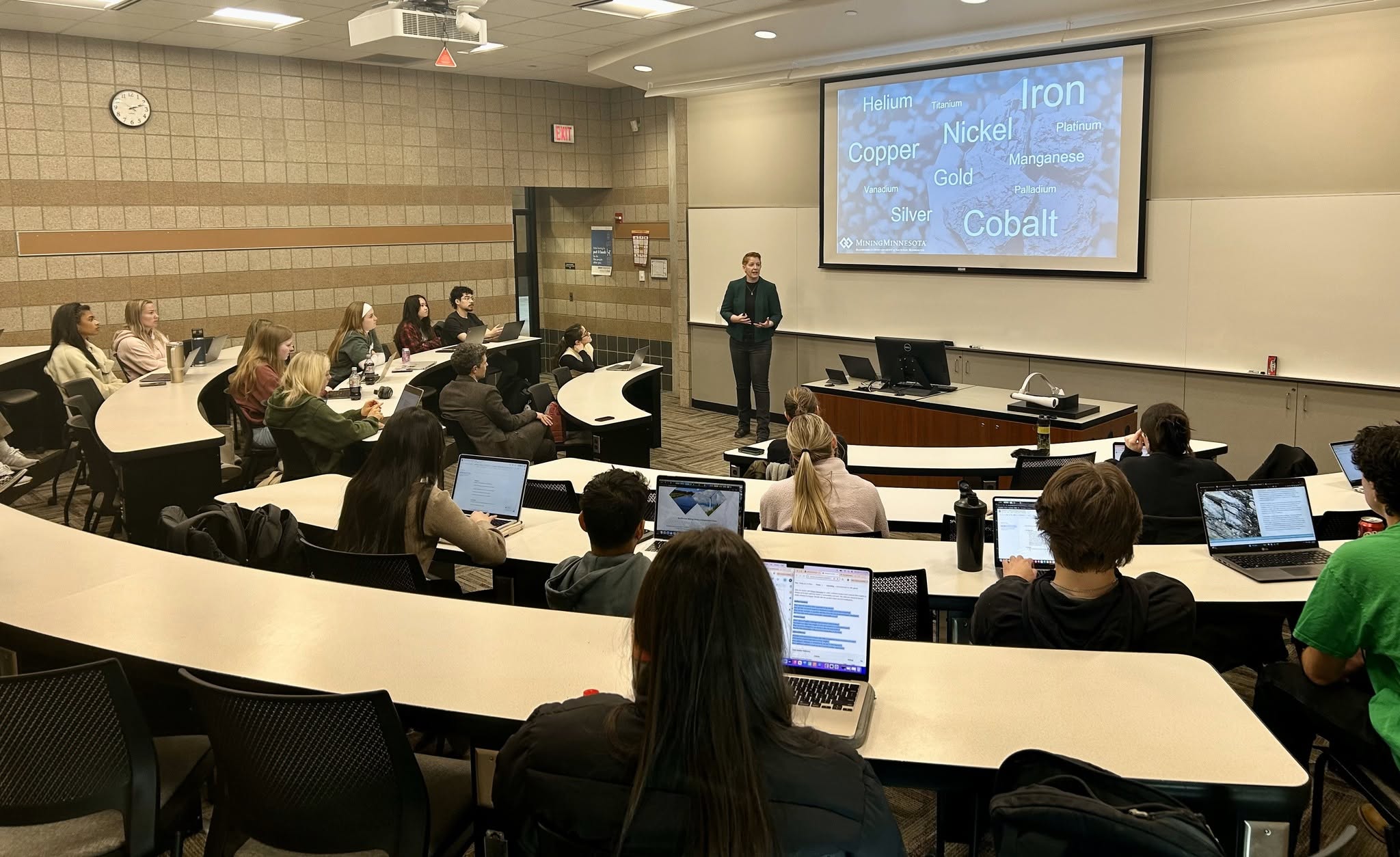
Resources for science teachers including information for agencies, books, podcasts, online classrooms & virtual field trips that outline our state’s geological resources, current mining operations, and proposed mining projects.
download full pdf guide request a classroom visitWhat products use minerals?
Minerals are essential to the products and infrastructure we use every day. They are found in buildings, roads, vehicles, appliances, electronics, medical equipment, telecommunications, and many other products. From the steel in a bridge to the copper in electrical wiring, minerals are fundamental to modern life.
Why are minerals important to clean energy?
Many technologies used to generate, store, and deliver energy require minerals. Copper is used extensively in electrical systems and power infrastructure, while nickel, cobalt, lithium, and other minerals are used in batteries and other energy technologies. As demand for electricity and new energy technologies grows, so does the need for reliable mineral supplies.
What are critical minerals, and why do they matter?
Critical minerals are minerals that are important to the economy or national security and have supply chains that may be vulnerable to disruption. Many are essential for manufacturing, defense, energy, technology, and infrastructure. Minnesota is home to deposits of several minerals that are considered critical to the United States.
Can we recycle our way out of mining?
Recycling is an important part of responsible mineral use and can reduce the need for newly mined materials. But recycling alone cannot meet all of our mineral needs. Minerals remain in products for years or decades, demand continues to grow, and some materials are difficult or impossible to recover economically. A secure mineral supply therefore requires both recycling and responsible development of new resources.
Do I really depend on mining?
Yes. Nearly everything we use, build, or rely on requires minerals at some point in its production. Our homes, cars, phones, roads, medical devices, electrical systems, and countless other products depend on mined materials. We may not think about mining when we use these products, but every one of us participates in the mineral economy.
How does mineral exploration work?
Mineral exploration is the process of identifying and evaluating areas that may contain valuable mineral deposits. Geologists use information about Minnesota’s geology, along with mapping, geophysical surveys, sampling, drilling, and other techniques to understand what is beneath the surface. Exploration helps determine the location, size, composition, and characteristics of a potential mineral deposit before a project can be considered for development.
How does a company determine whether a mineral deposit can be mined?
Finding minerals does not necessarily mean a mine can be developed. Companies must evaluate the geology, mineral quality and quantity, mining methods, economics, infrastructure, environmental considerations, and regulatory requirements. This extensive analysis helps determine whether a deposit can be developed safely, responsibly, and economically.
What is the difference between open-pit and underground mining?
The mining method depends largely on the location, depth, size, and characteristics of a mineral deposit. Open-pit mining removes material from a large surface excavation, while underground mining uses tunnels, shafts, or other methods to access deposits beneath the surface. Mine design is tailored to each deposit to safely and efficiently recover the resource while considering environmental and community impacts.
What happens to minerals after they are mined?
Mined material, or ore, is transported to a processing facility where valuable minerals are separated from the surrounding rock. Processing methods vary depending on the mineral and deposit and may include crushing, grinding, separation, concentration, and other processes. The resulting mineral products can then be used in manufacturing and other industries, while remaining materials are managed according to applicable environmental and regulatory requirements.
Why can’t we just dig up all of the minerals in a deposit?
A mineral deposit contains valuable minerals mixed with other rock and materials. Mining and processing are designed to recover the valuable minerals as efficiently as possible while safely managing the remaining material. The portion that can be economically and responsibly recovered depends on the geology, technology, economics, and environmental and regulatory requirements of each project.
How has mining changed over time?
Mining has evolved significantly through advances in science, engineering, technology, and environmental management. Modern mines use sophisticated equipment, data, monitoring systems, and engineering practices to improve safety, efficiency, resource recovery, and environmental performance. Today’s projects are also designed and evaluated under extensive environmental regulations that did not exist in earlier eras.
How does technology make modern mining safer and more efficient?
Modern mining uses technologies such as automated and remote-operated equipment, advanced geological modeling, real-time monitoring, precision drilling, and improved processing methods. These tools can help workers operate more safely, use resources more efficiently, reduce waste, and better understand and manage conditions throughout a mine’s life.
How does modern mining protect water and the environment?
Environmental protection is incorporated into mine planning and design from the beginning of a project. Modern mining can use engineered water management systems, water treatment, monitoring networks, enclosed processing and ore-handling systems, and other technologies designed to prevent or reduce environmental impacts. Projects must also meet applicable environmental standards and demonstrate compliance through ongoing monitoring and reporting.
Why is every mine designed differently?
There is no one-size-fits-all approach to mining. Mine design depends on the geology, depth and characteristics of the mineral deposit, surrounding environment, available infrastructure, economics, and applicable regulations. Engineers and scientists use this information to develop a project-specific approach to safely and efficiently recover the resource while addressing potential environmental and community impacts.
Can modern mining be different from mining in the past?
Yes. Mining practices, technology, environmental standards, and engineering have changed significantly over time. Modern projects are designed using current scientific knowledge and technology and must meet today’s environmental, safety, and regulatory requirements. Each proposed project should be evaluated based on its specific design, location, safeguards, and potential impacts.
Why is Minnesota geologically significant?
Minnesota has a diverse and unusually important geological history. The state’s rocks record billions of years of Earth’s history and contain significant deposits of iron ore, copper, nickel, cobalt, titanium, and other minerals. Minnesota’s geology is also part of what makes the state an important source of minerals used in construction, manufacturing, technology, and the clean energy economy.
Why does Minnesota have so much iron ore?
Minnesota’s Iron Range contains extensive deposits of iron-rich rock formed billions of years ago when ancient seas and geological processes concentrated iron minerals. Over time, these deposits were altered and exposed through tectonic activity, erosion, and glaciation. Today, Minnesota is one of the nation’s leading sources of iron ore, which is processed into taconite pellets used to make steel.
Does Minnesota have critical minerals beyond iron?
Yes. Minnesota’s geology contains deposits of several minerals considered critical to the U.S. economy and national security, including copper, nickel, cobalt, titanium, and others. The state’s unique geology has attracted exploration for these resources, including deposits that could contribute to domestic supply chains for manufacturing, infrastructure, and energy technologies.
Why can’t minerals simply be found anywhere?
Mineral deposits form through specific geological processes that occur over millions or billions of years. The type, concentration, and location of minerals depend on a region’s unique geological history. Minnesota’s mineral resources exist because of that history, which is why understanding geology is essential to responsible exploration, mine design, and resource development.
How old are Minnesota’s rocks?
Some of Minnesota’s oldest rocks are more than 3.5 billion years old, making them among the oldest rocks found on Earth. Across the state, different rock formations tell the story of ancient oceans, volcanic activity, mountain building, erosion, and glaciation. This geological history helped create the mineral resources Minnesota has today.
Why does mine permitting take so long?
Mining projects require years of exploration, engineering, environmental studies, baseline data collection, review, public input, and regulatory analysis before construction can begin. The length of the process reflects the complexity of developing a mine and the need to thoroughly evaluate potential impacts and environmental safeguards before decisions are made.
What does it take to permit a mine in Minnesota?
Developing a mine in Minnesota requires extensive environmental review, technical analysis, permitting, and public input before operations can begin. Project proposals are evaluated by state and federal agencies based on factors including mine design, water quality, air quality, wildlife, land use, reclamation, and potential impacts to surrounding communities. Permits establish requirements and conditions that a project must meet throughout its operation and closure.
What is an Environmental Impact Statement?
An Environmental Impact Statement (EIS) is a detailed analysis of a proposed project and its potential environmental, economic, and social impacts. It examines the proposed project, alternatives, potential impacts, and measures that could avoid or reduce those impacts. The process also provides opportunities for agencies, communities, tribal governments, organizations, and the public to review information and provide input.
Who regulates mining projects in Minnesota?
Mining projects can be subject to oversight from multiple state and federal agencies, depending on the project and the permits required. The Minnesota Department of Natural Resources (DNR) plays a central role in mine permitting and environmental review, while agencies such as the Minnesota Pollution Control Agency (MPCA), U.S. Army Corps of Engineers, U.S. Environmental Protection Agency, and others may have regulatory responsibilities.
Can a mining project be denied a permit?
Yes. Mining projects must demonstrate that they can meet applicable environmental, technical, and regulatory requirements. If a project cannot meet those requirements, permits can be denied or additional conditions may be required before approval. The permitting process is designed to evaluate whether a proposed project can be developed responsibly and in compliance with Minnesota and federal law.
How is the environment protected during modern mining operations?
Modern mining projects must comply with extensive federal, state, and local environmental regulations before operations can begin. These requirements often include environmental review, water quality monitoring, air quality standards, wildlife protection measures, and plans for reclaiming the land once mining is complete.
What is mine reclamation?
Mine reclamation is the process of restoring land after mining activities have ended. Reclamation plans are developed before a mine is permitted and may include reshaping the landscape, restoring vegetation, protecting water resources, and monitoring the site to help ensure long-term environmental stability.
How is water quality monitored around mining projects?
Water quality is monitored throughout the life of a mining project using sampling, testing, and reporting required by regulatory agencies. Monitoring may continue during operation and after closure to help verify that environmental standards are being met and to identify any issues that require corrective action.
Who oversees environmental regulations for mining in Minnesota?
Mining projects in Minnesota are reviewed and regulated by multiple agencies, including the Minnesota Department of Natural Resources (DNR), the Minnesota Pollution Control Agency (MPCA), the U.S. Army Corps of Engineers, and other state and federal organizations. These agencies evaluate permits, environmental impacts, and ongoing compliance throughout the life of a project.
How does mining benefit Minnesota communities?
Mining supports communities through jobs, wages, local purchasing, tax revenue, and investment. Mining operations and the businesses that support them create economic activity that reaches beyond the mine itself, supporting families, local businesses, schools, governments, and communities across the region.
What kinds of jobs does mining provide?
Modern mining requires a wide range of skilled workers, including equipment operators, electricians, mechanics, engineers, geologists, environmental professionals, laboratory technicians, and many others. Mining jobs often provide strong wages, benefits, training, and opportunities for long-term careers without requiring a four-year degree.
How does mining support local businesses?
Mining companies purchase goods and services from businesses throughout the region, including contractors, equipment suppliers, transportation companies, professional services, restaurants, and other local businesses. This spending creates economic activity that extends well beyond the mine site.
How does mining contribute to local and state taxes?
Mining operations contribute to Minnesota’s economy through a variety of taxes, fees, and other payments. These revenues can support local governments and public services, while economic activity generated by mining also contributes to broader state and regional tax bases.
Why do mining jobs matter to Minnesota communities?
Mining jobs provide opportunities for workers and families while helping sustain communities where mining has been part of the economy for generations. Skilled, family-supporting jobs can help people build careers, buy homes, support local businesses, and remain in the communities they call home.
Why doesn’t the United States have more domestic mining companies?
The U.S. mining industry has changed significantly over the past several decades. The U.S. Bureau of Mines, which conducted research and provided information about mining and mineral resources, closed in 1996 after 85 years of service, with some of its functions transferred to the U.S. Geological Survey. Today, mineral development is part of a global industry, and companies seeking to develop resources in the United States may have ownership, investment, or expertise from many different countries.
Why are some mining companies operating in Minnesota based outside the United States?
Mining is a global industry, and mineral companies operate and invest across national borders. Developing a mine requires significant technical expertise and capital, and companies with experience in geology, engineering, project development, and mine operations may be headquartered in different countries. A company’s headquarters does not determine where a mine is located, who works there, or which laws and regulations govern its operations.
Why does mining require so much investment?
Developing a modern mine is a major, long-term investment. Companies must spend years and significant capital on exploration, engineering, environmental studies, permitting, infrastructure, construction, and workforce development before a mine can begin producing minerals. Large-scale investment is necessary because mineral development is complex, expensive, and carries substantial financial risk.
Why is mining expertise found around the world?
Mineral deposits are found around the world, and mining companies and professionals have developed expertise in different types of geology, mining methods, processing, environmental management, and mine construction. Minnesota benefits from this global expertise while projects operating in the state must meet Minnesota and U.S. requirements.
Is mining a global industry?
Yes. Minerals are part of a global market, from exploration and investment to processing, manufacturing, and end-use products. Demand for minerals such as copper, nickel, iron, and other critical minerals extends far beyond Minnesota and the United States. Developing Minnesota’s resources can help connect the state to global markets while strengthening domestic mineral supply chains.




We are proud to partner with Range Engineering Council and raise funds to help teach students about the role of nonferrous mining and mineral development projects in relation to our state’s history, economy, and environment. Our goal is to develop K-12 educational materials that follow state science and social studies standards that focus on the relationship between industry and environment.
Make a tax-deductible donation now!